Saturday, October 12, 2013

The Month of October

by Tyler Dunahee

Fall is here in southern Illinois and will be in full swing as the leaves turn and temperatures cool in the coming weeks. Tis the time for bon fires, Halloween décor, pumpkin patches and apple orchards.  The month of October signals a number of things, the changing of the seasons being the most obvious as the warm days seem to stretch farther and farther into September.  The month of October is the “awareness month” of a number of things, the most familiar being Breast Cancer Awareness Month, but it also National Bullying Prevention Month, Cybersecurity Month, Adopt-a-Shelter Dog Month, Domestic Violence Awareness Month, amongst many, many other.  On an architectural note, the first Monday in October is considered World Architecture Day.
                For all the sports fans out there, October is probably the greatest month of the year.  Major League Baseball (MLB) Playoffs are starting (well at least for us Cardinal fans, sorry to those Cub and White Sox fans out there), the National Football League (NFL) is in full swing, as well is college football.  The National Hockey League (NHL) preseason has ended and regular season has begun.  Also, toward the end of the month we can begin to look forward to the start of the college basketball season, which for SIU, exhibition games tip off November 2nd here in Carbondale against Harris-Stowe. 
                For the television and video game junkies, there are a number of things to look forward to as well.  NBC has six new shows premiering this fall, The Blacklist, Ironside, Welcome to the Family, Sean Saves the World, The Michael J. Fox Show, and Dracula.  ABC premiers five news shows and FOX with nine new show premiering this fall.  As well as new shows premiering, there are a number of highly anticipated seasons returning.  Probably the most highly anticipated return is the fourth season of The Walking Dead on AMC, which premieres October 13th.  As far as video games go, the rest of the year is full of highly anticipated games, however for October, the top games have to be Battlefield 4, Grand Theft Auto (GTA) Online, and Assassin’s Creed IV: Black Flag. 
                There seem to be few highly anticipated movies released for the month of October, however there are a few to look out for.  Nationwide releases on the first Friday of the month (October 4th) include Gravity and  Runner, Runner. Runner, Runner possibly being the most anticipated of the month starring Ben Affleck and Justin Timberlake in a film about a Ivy League graduate student (Timberlake) takes on an online gambling tycoon (Affleck).  Other movies to lookout for in the month of October are Machete Kills, Captain Phillips, Romeo and Juliet, the remake of the horror film classic Carrie, Escape Plan, and The Counselor.  However, few of these movies are receiving high marks as the summer blockbusters did.  My advice, catch any summer blockbusters that you missed on DVD or bluray through your local video store or Redbox.

                For those of you in or around Carbondale, October means “Unoffical” Halloween is coming, and this year for the first time in 15 years the Halloween bar ban has been lifted. For those of you partaking in either or both events, I wish you all a fun, but more importantly safe end to the month.

Friday, October 11, 2013

Sunlight’s effect on Phoenix, Arizona

By Nick Mosher
The sunlight is a very viable tool that has been used since the first humans.  Capitalizing on it can lead to many positive effects such in regards to attitude, health, costs, performance, and ambiance. But just like anything, too much of it is harmful.  Phoenix, Arizona is known for being the hottest city in the United States.  Well over 100 days of the year the city has temperatures that exceed 100 degrees Fahrenheit.  This is primarily due to the constant direct sunlight that shines down.  With an average of 325 days of the year getting sunlight, this keeps the temperature up to points where it evaporates the moisture out of the air before it ever turns into rain (Sub Tropical Desert, 2013). This concentrated heat creates an uncomfortable level that causes the people to stay inside in the air conditioning.  This constant use of electricity to power the air conditioning unit causes costs to add up.  People are relying more on the artificial cooling systems for their homes and businesses instead of incorporating a hybrid use of artificial and natural technologies to keep spaces comfortable. 
            Not only does the intense heat from the sunlight increase bills, it also has been shown to increase irritability and aggression.  Consistent to the increase in temperature and aggression, there have also been studies that show the crime rates also increase.  Given the previous info, according to Craig Anderson, there is a correlation between how hot the temperature is and the crime rates (Baker, Brazel, Selover, 2003).  By using the passive solar techniques to create a cooler and more comfortable space both inside and outside, this can potentially reduce crime in that area. 
For the last fifty years in Phoenix, the population has been increasing as well as the average temperature.  The heat island effect is a condition created when an urban environment changes the landscape.  Open land gets replaced with roads, buildings, and infrastructure; which then causes the temperature around that area to become hotter than the surround land.  This is due to the sun warming up rooftops and pavements hotter than the air.  The objects being heated up then slowly release the heat creating the surrounding air to become hotter.  Adding this on top of the already hot climate of Phoenix makes it even more uncomfortable.  This has been proven in a study showing that the number of hours per day where the temperature is above 100 degrees Fahrenheit has nearly doubled in 2000 since 1948 (Baker, Brazel, Selover, 2003).  This means that it takes less time for the temperature to reach an uncomfortable level during the day and more time for it to cool off at night.  This has the potential to worsen as the population keeps growing past its 1.5 million people currently.  It can also become better by designing structures to help create more shading while not absorbing a lot of heat. 

Notes:
Sub Tropical Desert. (Viewed September 14, 2013) Climate. Retrieved from https://sites.google.com/site/subtropicaldesert//climate
Baker, L. A. Brazel, A. J. Selover, N. (2003). Urbanization and Warming of Phoenix (Arizona, USA): Impacts, Feedbacks and Mitigations. Retrieved from http://download.springer.com/static/pdf/378/art%253A10.1023%252FA%253A1026101528700.pdf?auth66=1379567532_0fa44f0d43a1d5993436888a87e50fc2&ext=.pdf


Ontology vs Phenomenology

By Michelle Harris
The study of ontology is the study of being. The study of phenomenology is the study of the experience of being. Neither of these are simple as all that. I recently was accused by a professor of sounding ‘hick’. After nineteen years of formal education I am embarrassed but also encouraged. Certain colloquialisms in my personality have me grounded in sounding unscholarly. Perhaps there is an elitism that is undervalued in my opinion. In the occasional conversation with my no-worries-neighbor there have been deeper moments of self-reflection than most scholarly conversations bring about. Recently while studying phenomenological principles the concept of emerging from poetics to living poetry arose. Poetry in phenomenology, as explained by the book, Poetics of Space, is a’ poetic image emerging into the consciousness as a direct product of the heart, soul and being of a man, apprehended in his actuality.’ Similarly, such is designing to experiencing design.
As a designer consideration of space becomes alive as we imagine experiencing the space. Personally, the guide of my imagination in design is not where the ripest experience lies. As a designer it’s in the final built environment. While this might be an arguable point for some, self-enlightenment, personal experience, the colloquial informs my experience of design.
This previous summer I was in a studio designing a winery. We toured Blue Sky Vineyard one afternoon, seeing the object of the facility: here is the bar, the bathrooms, the kitchen, the office, the wine making facilities. I recall taking notes about such features, anticipating some relevance in my design. Even so I wanted more perspective on winery design.
I visited eight wineries in two days in Napa Valley. I noted the bar, the bathrooms and other such essential items for a functioning winery. Yet I didn’t experience the space. I was on a determined path of noting, ‘What would the employees would change about the space?’ versus seeing how they operated in the space. I didn’t fully understand until I experienced a winery that exceeded my expectations.
This winery shook my imagined space requirements. It functioned so well as a winery, my experience was first. I was no longer Nancy-notetaker, instead I was a guest. I toured the winery twice. The first time as a guest and the second time through I was noting key elements in my experience. However even this was not enough for successful design.
The built environment I experienced was successful but it was not my design. The concept of spatial flow could be emulated, but I was doing a unique design. In this design I lost the principles of creating a sense of being a guest with creating an experience of an object. The personhood was lost as was the flow
Having flowing transitions is informed by the personhood. Another personal experience that informs this recollection is from my current position at Blue Sky Vineyard. There is a beautiful bar, a beautiful facility and landscape. However there is a similar principle of lost personhood. Instead, the experience is one of noting missing pieces. As an employee I saw there was another point of view to be explored.

While there are certain design elements that are invaluable to defining architecture the big picture is to create an architecture serving and creating poetics to inform the environment for the client. Needing more inspiration led me to realize that I should ultimately see the person in their environment even to the point of being them. This imagining is what makes the final built environment the fruition of design.

Life of a Saluki Architecture Grad Student

By John Svast

Howdy readers! 
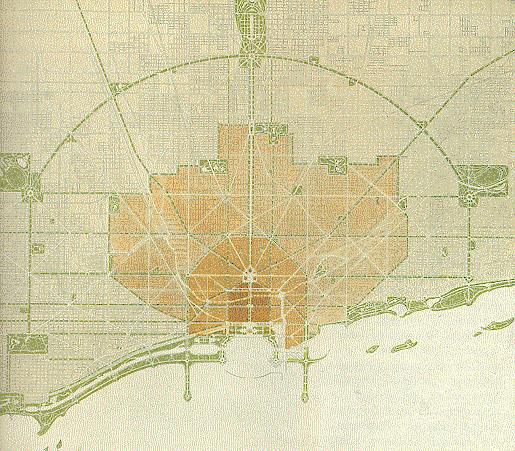
Have you folks heard of the Burnham plan?  You haven’t!  Great!  Take a seat while I blast you with my information shotgun!

The Burnham Plan is the Chicago urban design that was thrust forth into this world in 1909 by a pretty amazing guy by the name of Daniel Burnham.  Burnham is famous for not only his plan for Chicago but he is also half of the design duo of Burnham and Root.  I think of Burnham and Root at the Penn & Teller of their day.


We totally copied our Shtick from Burnham and Root…

Photo of Penn LEFT and Teller RIGHT
Penn and Tell totally copied our shtick
Photo of Burnham LEFT and Root RIGHT
Burnham designed several building including the Rookery, The Monadnock Building, and the Reliance Building.  He is also is famous for saying:


“Make no little plans. They have no magic to stir men's blood and probably themselves will not be realized. Make big plans; aim high in hope and work, remembering that a noble, logical diagram once recorded will never die, but long after we are gone will be a living thing, asserting itself with ever-growing insistency. Remember that our sons and grandsons are going to do things that would stagger us. Let your watchword be order and your beacon beauty. Think big”

It took a man like this to handle the big idea that we now know today as Chicago.  Would you like to see the plans?  I know you would!
1909 Burnham Plan
Do you like Grant Park?  Thank Burnham
Do you like the Lake Front?  Thank Burnham
Do you like all the Museums?  Thank Burnham
As a matter of fact, along with the several maps that Burnham provided he also included 6 items to focus on:
1)      improving the lakefront
2)      developing a highway system
3)      improving the freight and passenger railway systems
4)      acquisition of an outer park system
5)      arranging systematic streets; and
6)      Creation of a civic center of cultural institutions and government.

Why am I bringing this all up?  For our design for studio we will be implementing a lot of Burnham’s ideas into our design due to the fact that 290/Congress Parkway was going to be this grand green boulevard with parks dotting along the way.  We are going to design a new park on the near west Side.  Horary!
Here are a handful of photos of the progress I have thus far in studio:


Photos By Author

Wednesday, October 9, 2013

Blog #3

By Randy Thoms

            This week, or rather two weeks since my last post deadline, has quickly rolled on by like glacier moving down a slope.  Yes, quickly rolled and glacier moving seem to be as intrinsically bi-polar as hot and cold.  But is that not how life and times move…fast followed by slow? As they in the construction business, “Hurry up and wait.” So much time is spent framing and forming, only to wait for sheetrock mud and concrete to dry.
Nonetheless, life is moving fast and uncompromisingly forward, which reminds me of another saying, this time from the truck driving industry, “Always forward never straight.” As in life, like driving, you want to move forward with a goal or a path, not just straight.  If one goes straight in life, as the saying goes, “On the straight and narrow,” much can be missed. Your focus can be limited and not get the bigger picture. But by moving forward, one can experience life by taking twist and turns while progressing, forward, in one’s ideas and thoughts. 
So here I am, again sitting in studio writing this and not working on studio stuff – don’t tell McDonald or Trunipseed – and trying to figure out what next to do.  After a week of something due every day, as related to my past two posts, we all moved into a week of nothing due, save a studio site model, an adventure in itself…but more on that subject another time. 
And now a week of finalizing master plans, personal buildings, thesis writing and research keeps us rolling right along…like a glacier, moving uncompromisingly forward down the slope in a valley, scraping the sides, adding to it’s mass, then grinding, mixing it all together only to be deposited at the foot of the glacier in lateral moraines.  
Much like the process of architecture, a mixing of ideas and experiences that are suppose to coagulate into a cohesive form and or function. We do this, I think so, by scraping up ideas from our peers, idols and mentors.  Then as we travel and experience life and the world at large, we begin to form a thesis in our own minds of what appeals and excites our passion.  Concurrently, by way of grinding and mixing of case studies and research, we hopefully add to our body of knowledge, therefore, in turn, depositing a design that hopefully works and is pleasing and appealing at the same time.
All of this blends together to form, shape and mold a student into an architect, well, at least a graduate from a Masters program in Architecture. But then again I could be wrong about everything, I am coming off a cold, a few days of little sleep and drugs, cold medicine that is, not the recreational stuff….whatever that is…..

The Ethos of Computational Design

Joshua Fowler here speaking toward the digital culture involved in computational design:
             Current mainlines of knowledge already established in regards to computational and parametric algorithmic design are established through a complex network of inter and cross-disciplinary channels varying from material science to mathematics to robotics and more. All of these interdisciplinary factors culminate within the knowledge base of computational design. Foster + Partners SMG (Specialist Modeling Group) harness this notion of inter and cross-disciplinary studies within its group members from such disciplines as fine arts, mathematics, industrial design, mechanical engineering, building physics, physical computing, fabrication, and acoustics; melding of such disciplines opens opportunities for unique design solutions which may not have emerged from a more traditional, homogeneous group.[1] An excellent resource for researching the implementations and mainlines of knowledge is the magazine Architectural Design. This source's basis explores various architectural design theories, implementations, etc; with several issues focusing on algorithmic thought, mathematics of space, material computation, as well as numerous other issues regarding research directly pertaining to computational design's influence on architecture, and also contains pertinent case studies for reference.
            Current theories relating to computational design lie primarily in the dialogue between efficiency opportunities and architecture, as well as the opportunities for vast complexities in the tectonics and aesthetics of architecture. Generative algorithmic design has proven that it can not only free architecture from the bonds of fixed catalogs and types, but it also changes the scope from the production of single objects toward the possibility of a range of objects.[2] An additional line of knowledge and theories which lie in the parallel to variations and evolutionary biology as described in The Architecture of Variation edited by Lars Spuybroek. All of these theories and lines of knowledge have valuable lessons to gain and branches of thought which could bifurcate into new lines of thought. Due to the relatively recent nature of computational design and the implementation of emerging technologies there are various opportunities which lie ahead for the dialogue between computation and architecture. 
            There are several theoretical implementations and points of view on the subject of generative algorithmic design as mentioned before. There does, however, seem to be certain subjects which speak to computation more so than others. Such points of view are established in similar areas of computation itself such as robotics and engineering, or just about anything dealing with computers, mathematical equations, matrices, etc. While such points of view parallel closely with computation, this leaves room for further exploration into non-traditional uses of computational design. Ideologically the ideas which this study intends to explore are fields of genetic variation and its relationship with architecture as well as the reflexivity and responsiveness opportunities for architecture and its context.
            There are several names and iconic works which are emerging in the field of computational design. It is crucial to the validity of this study to extensively research the current and past projects and to analyze the theories and practices of those at the forefront of generative algorithmic design. The Architecture of Variation edited by Lars Spuybroek, Explores the relationship between uniformity and variety, in both an evolutionary and textile standpoint, with an emphasis on computer numerical control. This is a culmination of the research done by Lars along with students and research participants at the Georgia Institute of Technology's College of Architecture. This literature provides prime precedence for the language spoken between different inspirations of design, specifically textile, and the extrapolation of that inspiration into computer numerical controlled models and designs. Some of the language to pull from this literature is the concept that computation is a tool by which a designer can utilize to further his/her design and thought process and should not necessarily be considered as either a starting point or the only aspect of the design. There must exist the parameters of conscious design input from the designer and use of computation as a tool in designing rather that treating the tool as the designer. Additionally, a dialogue between the influence of patterns and computation also permeates this literature and provides precedence.


[1] Peters, Brady. "Computation Works: The Building of Algorithmic Thought." Architectural Design Vol. 222, 2013.
[2] Spuybroek, Lars, ed. Research & design: the architecture of variation. Thames & Hudson, 2009.

Tuesday, October 8, 2013

Making Time to Read

By Timothy Shotts
            I never thought I would be reading this much while working on a Master’s degree in Architecture.  I have always written down the names of books and authors that architects and designers reference in lectures, but rarely have I had the time to do more than thumb through the book before getting back to more immediate concerns of school.  In Prof. Anz’s research methods class we’re required to read.  A LOT.  It’s great, really. 
            Archigram is currently my favorite out of the list you’ll find at the bottom.  Peter cook was pushing the frontier of efficiency in architecture – not in terms of energy, but in that of usefulness.  He stresses flexible, temporary pieces of architecture that can be replaced as our needs change. 
            Elon Musk is pushing the frontier in high speed transport.  Unhappy with the speed and cost of California’s High Speed Rail project, He proposed one similar to past tube transport systems.  I imagine the man behind Paypal, Tesla motors, and Space X has some engineers on hand to work out the details of this.
            Future Transport in Cities looks at how public transport has been dismissed ever since the popularity of the private car.  It looks at how the private car has ruined cities during the past 60 years.  It looks at strategies used around the world for transit in cities and how our future cities can be designed without cars.
            A final note:  Casey Neistat is an amazing film maker.  Go watch all his movies.  He lays out how he made a car commercial at http://www.youtube.com/watch?v=qPcxxeZPhvM&list=SPTHOlLMWEwVzBaZQu6jfATpqeQfN0LvHl .  Now go to 2:26.  Explanation, research, production, greatest car commercial ever.  Hey!  That’s not too different than creating the best piece of architecture ever… 
           
This is what I’m currently reading:
1.      Elon Musk, August 12, 2013, “Hyperloop”.  http://www.teslamotors.com/blog/hyperloop
2.      Salter, R. M. "The very high speed transit system." (1972).
3.      Et3.com. "Why ET3? | Evacuated Tube Transport Technologies." 2013. http://www.et3.com/ (accessed 15 Sep 2013).
4.      Gilbert, Richard, and Anthony Perl. 2008. Transport revolutions moving people and freight without oil. London: Earthscan.
5.      Richards, Brian. Future transport in cities. London: Spon Press, 2001.
6.      Daniel Kraffcyzk, April 22, 2013, “The Aeroscape:  an Approximation”. http://aeroscape.org/tag/architecture/
7.      Cook, Peter. Archigram. New York: Princeton Architectural Press, 1999.
8.      Sadler, Simon. 2005. Archigram architecture without architecture. Cambridge, Mass: MIT Press
9.      Latour, Bruno. 1996. Aramis, or, The love of technology. Cambridge, Mass: Harvard University Press.
10. Easterling, Keller. 1999. Organization space: landscapes, highways, and houses in America. Cambridge, Mass: MIT Press.
11. Wolsen, Marcus, October 1, 2013.  “When Sharing Doesn’t   Make Sense in the Sharing Economy”.  http://www.wired.com/business/2013/10/relayrides-drops-hourly-rentals/
12. Sinson, Liz.  October 1, 2013.  “How Do You Design a Hospital That Can Foster Great Ideas?”.  http://www.wired.com/design/2013/10/this-hospital-was-designed-to-be-an-innovation-hub/
13. Midwest High Speed Rail Association. “The Economic Impacts of High Speed Rail:  Transforming the Midwest”.  http://www.cnu.org/sites/www.cnu.org/files/mhsra_

2011_economic_study_brochure.pdf